How does AI-generated content affect SEO?
Using ChatGPT and other AI tools to create website content has become common practice. Companies use artificial intelligence to produce articles and descriptions of products and services.
There are already many examples across the web where developers integrate AI models to automate the entire process — from generating content to creating meta tags and translations.
For example, an online store can receive a product list from its accounting system, after which AI generates a product description of a specified length based on each product's name and type, translates it into the website's other languages, creates the meta title, description and alt attributes, and then automatically publishes all this information on the relevant pages.
This raises a logical question: how does Google evaluate AI-generated content, and how does it affect SEO?
One thing is certain: abusing the capabilities of artificial intelligence can have serious consequences.
Google does not penalize websites simply for using AI. It targets the large-scale creation of content that provides no real value to users. Violating Google's Scaled Content Abuse policy can result in a website losing rankings or being removed from the search index.
What is scaled content abuse and how can it affect a website?
Google's Scaled Content Abuse policy came into effect in 2024 as part of its spam policies.
Under this policy, Google considers the large-scale creation of pages containing low-quality content to be an abuse. The method used to create that content is not the key factor. The content may be generated by artificial intelligence, automatically collected through scraping, or written by low-cost copywriters.
When evaluating website quality, what matters to Google is primarily how useful the content is to the reader.
The main types of violations include:
- Large-scale, low-quality content. Creating dozens or hundreds of pages where primarily the keywords change while the content remains repetitive and provides no real value. This problem is particularly common among e-commerce websites.
- No Added Value. Essentially, this is a form of rewriting where existing content is simply edited or rephrased without adding first-hand experience, original conclusions or unique information.
- Mass generation of pages targeting low-volume keywords. This approach is particularly common among SEO "specialists" whose knowledge comes exclusively from impressive-looking Reels.
What are the possible consequences?
- Manual Actions. Google Search Console may display a notification about a policy violation. A website can disappear entirely from search results, or individual sections may lose virtually all of their organic traffic.
- Algorithmic ranking decline. Google's quality evaluation systems may reduce a website's search visibility if a significant portion of its content consists of low-value generated material.
What can "kill" your online store?
Recently, the Astudio team developed an online store for a large company. While discussing SEO and ongoing content management, the client was surprised to hear that we planned to create the product descriptions ourselves.
One of our competitors had proposed using a "small" AI integration to automate the entire process: scraping photographs from other websites, automatically generating product descriptions, translating the content and publishing it.
Leaving aside the legal and ethical issues surrounding the scraping of copyrighted photographs, we explained to the client that automatically generating AI content for 20,000–40,000 products could seriously jeopardize the online store's indexing and SEO performance.
How should AI be used properly?
AI tools can significantly accelerate content creation, help gather information, build an effective content structure and analyze large volumes of data.
We also used Gemini and ChatGPT while preparing this article. With the help of AI, we collected and verified information, analyzed Google's official documentation and found examples of penalties resulting from the violations described above.
We then added Astudio's practical experience, analyzed our own cases and wrote the article from scratch, presenting the subject from our own expert perspective.
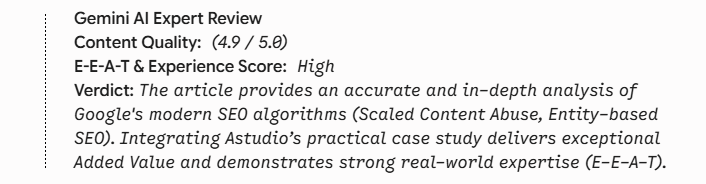
At the final stage, we checked the article's uniqueness, assessed its potential value for SEO, and used Gemini to perform an additional analysis of the accuracy of the facts presented.
The process of creating a valuable SEO article can be summarized as follows:
- selecting the topic and analyzing target keywords;
- researching the subject and preparing source material;
- adding your own cases and expert insights;
- SEO editing and publication.
If you want to attract relevant audiences from Google, you will increasingly need to follow this approach to content creation. Search engines themselves continue to evolve their algorithms while making search results increasingly personalized.
A brand is becoming a distinct entity for Google
Google is fundamentally changing its approach to search. Alongside the development of AI-powered Search, AI Mode and agentic systems, search personalization capabilities are expanding, including Preferred Sources.
In the future, having SEO-optimized pages alone will not be enough to achieve strong positions in Google. High-quality content from brands that users trust and choose as preferred sources of information will increasingly gain an advantage.
In 2026, Entity-based SEO plays an important role in how search engines understand information. Google's Knowledge Graph enables Google to recognize brands as distinct entities and establish relationships between them, their attributes and other entities.
How does this approach work?
- A brand is considered a real-world entity with specific relationships and attributes, such as its location, founders, services, customer reviews, case studies and other information.
- Google's Knowledge Graph collects and cross-references information about these attributes from various sources, including Wikipedia, Wikidata, the company's official website, social media, Google Business Profile and other resources, connecting this information to the corresponding brand entity.
- Signals associated with E-E-A-T help Google evaluate the experience, expertise, authoritativeness and trustworthiness of a source within a particular industry or topic.
Modern SEO is no longer just about having pages optimized for keywords.
A brand's online reputation, citations and mentions, as well as its expert presence in relevant content and professional discussions, are becoming increasingly important.
The Astudio team provides expert assistance not only in developing a digital strategy. We are also ready to provide comprehensive SEO promotion services with contractually guaranteed results.
Get a consultation and cost estimate for your project. We will propose the most effective solution for your case.
Appearing in ChatGPT and other AI system responses depends on how well your website content is structured and how easily it can be understood by AI models.
Key factors include:
- Creating clear and useful content
- Using simple and natural language
- Adding an FAQ section
- Implementing Schema.org markup
- Having mentions and backlinks from trusted sources.
SEO improves a website’s visibility in search engines like Google.
What types of SEO are there?
- On-site SEO – Optimizes content, page structure, and keywords.
- Off-site SEO – Builds links and improves site authority.
- Technical SEO – Enhances site speed, mobile usability, and security.
AI (Artificial Intelligence) is a technology that enables automated models to perform “intellectual” tasks. AI can:
- Analyze large volumes of data
- Learn from past experience
- Predict outcomes using mathematical calculations
- Answer questions based on available data
- Generate text and visual content, and more.